
In partnership with

Hi Greek Talkers!
This week we have a young team from Nafpaktos making a great discovery, the first Greek woman to win the women’s Spartathlon, Athens ranking among the world’s happiest holiday cities, and Greeks cutting back on cafés without making the mistake of cutting back on coffee.
We’re also heading east to Sitia, where the palms are wild, the Minoan palace was found remarkably intact, and apparently Crete once had rhinoceroses.
Let’s dive in. ☕🤿🇬🇷
Smart starts here.

You don't have to read everything — just the right thing. 1440's daily newsletter distills the day's biggest stories from 100+ sources into one quick, 5-minute read. It's the fastest way to stay sharp, sound informed, and actually understand what's happening in the world. Join 4.5 million readers who start their day the smart way.
🇬🇷 WHAT’S NEW IN GREECE
🐝 Students from Nafpaktos won an international physics innovation award for finding a chemical-free way to fight the Varroa mite, a global bee killer adults have been struggling with for years. Bravo!! 👏 🇬🇷

🏃 An evening jog turned into Greece’s first female Spartathlon victory, so hobbies can escalate indeed.

More news from Greece
🔐 Mind The Hack, a Greek company that stops hackers, made Sifted’s list of Europe’s fastest growing companies. 👏 👏
🏙️ Athens is officially the world’s fourth-happiest city to visit! (emp:asis on “to visit.”).
🦏 Crete has added prehistoric rhinoceroses to an already unreasonable amount of backstory.
☕ When the expense is negotiable but the caffeine is not - 46% of Greeks plan fewer café visits, but coffee sales are rising.
🏺 Greece and Bulgaria completed a 1-for-48 cultural trade: one medieval tsar for 48 religious relics.
🎓 America’s second-oldest university is exploring a campus in Greece, a country that will be unimpressed by the “founded in 1693” tagline.
💰 Greek offices and warehouses are beating Greek bonds on yield, an unexpected promotion for concrete.
🌎 WHAT’S NEW OUTSIDE OF GREECE
🇦🇺 Seventeen Greek-Australian students headed to Mycenae, Nafplio, Epidaurus and Delphi, which is what happens when Greek school gets a travel budget.

More news from outside of Greece
🎓 Forty Greek-American students will split $250,000 in scholarships; Hellenic engagement now has a cash value.
🌍 After 30 years supporting children in Greece, Together for Children is reaching toward the diaspora with a fairly simple proposition: if you still care about the place, here is something concrete to do
🎶 Greek-language learning in Australia now comes with The Wiggles, backup dancers and significantly better production values than Saturday Greek school ever had.
Got a burning question about Greek culture, diaspora life, or that family tradition nobody can explain?
💌 Send it to [email protected] - your question might become next week's featured Q&A.
💎 CULTURAL GEMS
🏛️ The Spartathlon, the Run Behind the Run

Everyone knows the story. Pheidippides runs from Marathon to Athens, announces the Greek victory and drops dead. It gave the modern Marathon its name and has left millions of people limping through city centers in foil blankets taking selfies ever since.
The trouble is that Herodotus doesn’t tell that story but a much stranger one. Before the Battle of Marathon, the Athenians sent Pheidippides to Sparta to ask for help. He left Athens and reached Sparta the next day, a journey of roughly 245 kilometers through the mountains of Arcadia, which, for those in the know, is fairly unfriendly terrain. Somewhere along the way, according to Herodotus, Pheidippides also met the god Pan, who wanted to know why the Athenians weren’t paying him enough attention.
Pheidippides finally reached Sparta, made his case and was told the Spartans would absolutely help, yes, just not until the full moon. So after running the equivalent of nearly six marathons, he turned around and run back to Athens.
The famous Marathon-to-Athens story appears much later. Plutarch tells of a messenger who ran from the battle and died after announcing the victory, but gives him a different name. A century later, the satirist Lucian calls him Philippides and gives us the version we recognize today.
And even the 26.2 miles came later. The first modern Olympic marathon was run in 1896, but today’s exact distance dates to the 1908 London Games.
In 1982, RAF officer and ultrarunner John Foden decided to see whether Herodotus’s version was physically possible. He and two colleagues followed the ancient route from Athens to Sparta and they made it. The Spartathlon began the following year. Today runners have 36 hours to cover 244.7 kilometers, including the climb over Mount Parthenion at night, before finishing at the feet of the Leonidas statue.
This year, 34-year-old Greek lawyer Despoina Simantrakou won the women’s race in 24 hours, 45 minutes and became the first Greek woman to do it. Her running career began ten years ago when, as she puts it, one evening she simply decided to go out for a run. Clearly, ten years later, “I’m going for a run” has escalated considerably.
📆 BEST OF GREEK CALENDAR
📖 November 9, 2026, “On translating Homer - Again”, NYU, NYC
🎤 December 19, 2026, Bryan Adams, Athens
🧳 TRAVEL NEWS
🏖 Sitia, the End of Crete Where the Palms Grow Wild.

Keep driving east on Crete, past Heraklion, past Agios Nikolaos, past the point where the rental car map starts to look less confident, and you reach Sitia. It is a proper town, not a resort pretending to be a proper town. There is a harbor, a Venetian fortress above it, fishing boats, cafés, and far fewer people than you find in western Crete.
The rhinoceros skull in the news this week came from this part of the island, inside the Sitia UNESCO Global Geopark, where the rocks record almost 300 million years of history. An 8-million-year-old rhino feels oddly plausible here.
About 25 kilometers east is Vai, with one of Europe’s largest natural palm groves running almost to the beach. The palms are native to Crete, Phoenix theophrasti, and the place looks completely wrong for Greece until you remember Crete has never been especially interested in behaving like the rest of Greece.
On the way is Toplou Monastery, founded in the medieval period and fortified against pirates. During Ottoman rule it was allowed to keep a cannon for defense, which is where its name is thought to come from. These days the estate produces wine and olive oil, a calmer line of work.
Keep going south and you eventually reach Kato Zakros, where archaeologists uncovered a major Minoan palace in 1961. It is the fourth-largest palace complex on Crete and was found unusually intact. You can reach it through the Gorge of the Dead, named after the Minoan burials found in caves along the cliffs.
Back in Sitia, Vitsentzos Kornaros, author of Erotokritos, was born in the wider area. The town also has its own PDO olive oil, and a few kilometers inland the Arapitsa-free version of this trip is Richtis Gorge: plane trees, water, a waterfall and a walk down toward the coast.
Sitia is not hard to get to. It is just farther than most people bother going, which helps.
🌴 Vai, early
Go before the buses arrive. Walk up to the viewpoint above the beach before you settle in.
🏛️ Kato Zakros
Do the gorge and the palace in the same day if you have the legs for it.
💧 Richtis Gorge
A very good antidote to another day of ruins. Trees, running water, a waterfall, then the sea.
🍷 Toplou Monastery
See the monastery, then stop at the estate shop for wine and olive oil.

Vai beach


Toplou

🧑🍳 RECIPE OF THE WEEK
Chochlioi Boubouristi, Cretan Fried Snails

Snails, straight from the garden after the first rain, fried in olive oil with a handful of coarse salt and a sprig of rosemary, then hit with a splash of vinegar that makes the pan hiss. The name means "face-down," for the way they're set in the oil. Every Cretan grandmother makes them, every Cretan grandchild claims to hate them, and the plate is always empty. Eat with bread, a glass of raki, and no squeamishness.
💡 INSPIRATION
The measure of a man is what he does with power.
😎 GREEK FYI
🇬🇷 The wild palms at Vai are Phoenix theophrasti, a species found in only a handful of places. The name comes from Theophrastus, Aristotle’s successor, who wrote one of the earliest serious works on botany and described Cretan palms more than 2,000 years ago. So last week’s Aristotle piece and this week’s beach are unexpectedly connected.
Botanists only formally recognized the palm as a separate species in 1967. Theophrastus was onto it around 300 BC, with no lab, no Latin name, and definitely no rental car.
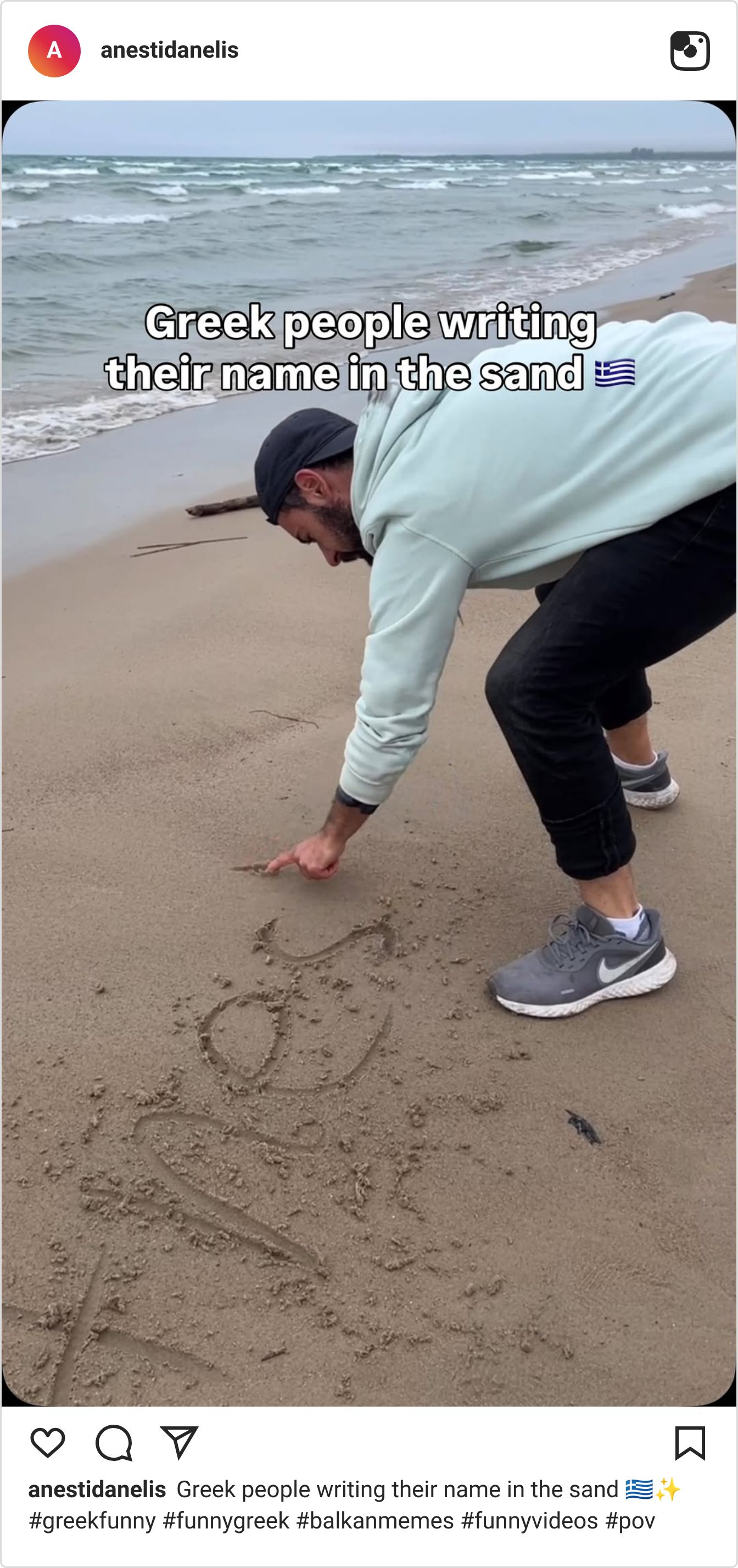
😂 MYTHIC MEMES
OMG CEASE AND DESEASED?????


That’s it for now. We ran from Athens to Sparta, drove all the way to the eastern end of Crete, met a prehistoric rhino and confirmed that Greek coffee remains economically non-negotiable.
Catch you next week for more news, drama and deep dives. 🧿 Stay Greek. [email protected]
