
Hi Greek Talkers!
Eighty-five thousand people ran the Athens Marathon on Sunday. The winner did it in two hours and ten minutes. The last man home was 75, barefoot, in a bronze helmet, and carrying a shield 👏 👏
Also: the EU is coming for Greek cigarettes, a Greek Australian pilot flew the first plane out of Sydney’s new airport, and a dentist made Forbes 30 Under 30.
Let’s dive in. ☕🤿🇬🇷
The Face Cream Proven to Boost Collagen by 28%*

As we age, our skin naturally loses collagen, elastin, hyaluronic acid, and barrier integrity. Powered by their age-reversing OS-01 Peptide™, OneSkin’s new OS-01 FACE RICH CREAM helps rebuild the structure that holds moisture in—delivering deep, lasting hydration and visible firmness, for resilient skin that keeps up with you.
🇬🇷 WHAT’S NEW IN GREECE
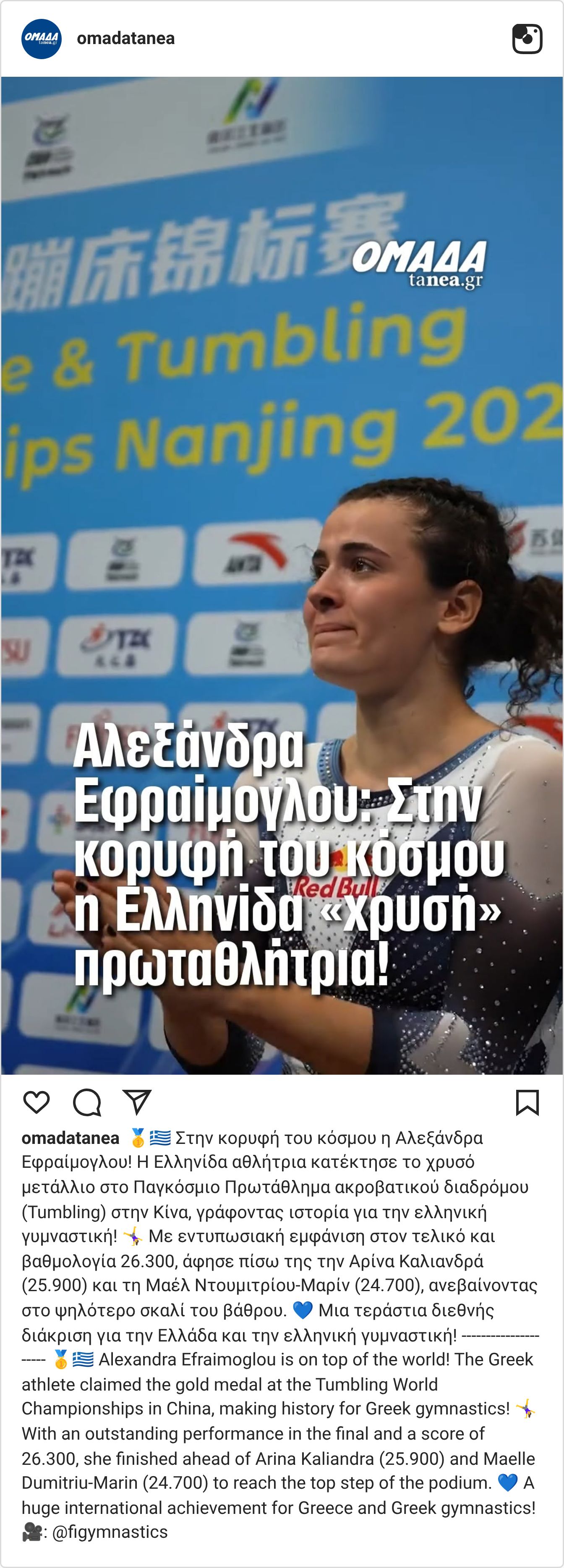
🥇 Efraimoglou wins debut world title in tumbling 👏 🇬🇷 👏 🇬🇷

🏃 At 75, Crete’s Idomeneas Avramakis finished the Athens Marathon barefoot, carrying a sword and shield. 👏🇬🇷 👏 🇬🇷

More news from Greece
🎬 Papakaliatis announced Maestro’s December Netflix finale, with six episodes approaching feature-film length; clear your evenings, plural.
🚬 Proposed EU tobacco taxes could push up Greek cigarette prices (13 euros), threatening to turn the coffee-and-cigarette ritual into a two-item budget meeting.
🪙 Greece finally passed the crypto tax, 10% on gains from 2027, after talking about it for so long that the coins in question have gone up, crashed, and recovered twice.
🧾 Bakery chains, pizza stores, nightlife businesses and a charity all feature in separate tax-and-fraud probes; forensic accounting is having a moment.
🌎 WHAT’S NEW OUTSIDE OF GREECE
✈️ Greek Australian Aglaya Papas, 25, co-piloted Western Sydney Airport’s first passenger departure (with her mother unexpectedly aboard).

More news from outside of Greece
🎉 Nearly 20,000 people attended Portarlington’s second Greek Festival, which is an ambitious interpretation of keeping things small this year.
🎓 A new A$2.5 million Andrianakos Foundation donation will support diaspora research at Melbourne, where questions about where we come from can now receive properly funded answers.
🏆 A biography of Alexander the Great became the first ancient-history book to win the Baillie Gifford Prize, a category he has taken his time entering.
Got a burning question about Greek culture, diaspora life, or that family tradition nobody can explain?
💌 Send it to [email protected] - your question might become next week's featured Q&A.
💎 CULTURAL GEMS
🏛️ Nobody Called Him “The Great”

Most of us meet Alexander at school, with “the Great” already attached, so it leaves very little room for introductions. Yet, as far as the surviving evidence tells us, nobody called him that during his lifetime. The earliest surviving reference appears more than a century after his death, in a comedy by the Roman playwright Plautus, who evidently expected his audience to know whom he meant. By then, Alexander was already passing into other people’s stories. Durham classicist Edmund Richardson has spent ten years trying to find the person inside them. His biography, Alexander: God, King, Man, has just won the Baillie Gifford Prize, the first book about ancient history to do so.
At twenty, Alexander inherited his murdered father’s throne, debts and an army whose loyalty he could not assume. Two years later he crossed into Asia and he would never return to Macedonia. His route took him through the cities of Persia, into Egypt and across mountains to the rivers of what is now Pakistan, where his exhausted soldiers eventually refused to follow him any further. There were new cities along the way, and ruined ones. He died in Babylon at thirty-two, leaving his generals to fight over an empire that had depended rather heavily on his being alive. In the centuries afterwards, Greek became a shared language across much of that vast territory, carrying trade, scholarship and ordinary correspondence between people who would never have met otherwise.
Richardson worked with sources in twelve ancient languages, often contradictory, to recover something of the young man who set all this in motion. There is still a great deal we cannot know about him but the familiar adjective has made that surprisingly easy to forget.
📆 BEST OF GREEK CALENDAR
🇨🇦 November 14, 2026, Hellenic Home Annual Gala, Toronto
🇦🇺 November 15, 2026, Philhellenika Greek Festival, Greek Events, Melbourne
🇩🇪 Nov. 20–22, 2026, Greek Theater Festival Berlin, Berlin
🧳 TRAVEL NEWS
🏖 Marathon the place, not the race.

Every November, thousands of people arrive in Marathon and immediately try to get to Athens. It could give a town a complex. Yet about an hour northeast of the capital, there’s a perfectly good day out waiting for anyone willing to stay. You can visit a battlefield, walk beside the sea and have lunch sitting down. The runners have made this considerably harder than it needs to be.
Start with the burial mound, where the cremated remains of the 192 Athenians killed in the battle of 490 BC lie beneath nine metres of earth. Walk around it and look across the plain. For once, the famous event and the place where it happened haven’t become separated by a museum label. The archaeological museum at nearby Vranas is worth the short drive, with ancient grave finds, fragments of the victory monument and Egyptian-style statues from a Roman sanctuary down the coast. There is also the matter of the name: Marathon is generally understood to mean “place of fennel.” An awful lot of expensive trainers for a field of herbs.
Beyond the plain is Schinias, a long sandy beach backed by protected pine forest, where walking slowly is an entirely respectable activity. Farther north, Rhamnous has the remains of a fortified town above the Euboean Gulf and a sanctuary to Nemesis, who punished arrogance. According to Pausanias, the Persians brought marble for a monument to their expected victory at Marathon. After their defeat, it became her statue instead. They had, in other words, packed the trophy before playing the match. It’s a legend, but you can see why the Athenians kept it in circulation.
⚱️ The mound and museum: Separate stops, both worth allowing time for. Visit the mound from the designated paths, then head inland to the museum at Vranas.
🏖️ Schinias: Bring something to eat and leave time for the beach and pine forest. This is protected national-park land, so follow access rules.
🏛️ Rhamnous: Go for the remains of an entire settlement as well as the sanctuary.
💧 Lake Marathon’s marble dam: An inland detour rather than a quick stop along the beach road. Completed in 1929, the dam is faced in Pentelic marble, with a small replica of the Athenian Treasury at Delphi below it. Athens needed a water supply and gave it a classical reference. Access to the lower monument should be checked separately.

Burial Mound

Arch. museum

Marathon dam

Schinias beach
🧑🍳 RECIPE OF THE WEEK

The runners can keep their energy gels. We’re having marathokeftedes: island-style fennel fritters made with chopped fennel, onion, spring onion and enough flour and water to hold the operation together, then fried in olive oil until crisp at the edges. No pastry to wrestle with, no cheese taking all the credit. The only hard part is the fennel. If you can’t find wild, use the feathery tops of a supermarket bulb and don’t tell anyone.
💡 INSPIRATION
Nenikēkamen
😎 GREEK FYI
🇬🇷 Marathon means “fennel field.” The plain was covered in wild fennel, marathos, in 490 BC, and the Greeks named the battle after the weed. Twenty-six miles of agony in every city on earth, named after a herb
😂 MYTHIC MEMES


That’s it for now. A 75-year-old ran 42 kilometers barefoot so the rest of us could feel bad about skipping the gym, and a Durham professor spent ten years in twelve dead languages so we could learn Alexander was just Alexander
Catch you next week for more news, drama and deep dives. 🧿 Stay Greek. [email protected]
